





The best starting words for five-letter puzzles are the ones that test the most common letters in the first guess. Good openers use five different letters, include two or three vowels, and avoid rare letters like Q, Z and X. In our list of 3,000 common English five-letter words, E appears in 47% of words, S in 44%, A in 38%, R in 32%, O in 29% and T in 27%. This guide turns those numbers into a simple plan.

What makes a good first word
- Five different letters. A repeated letter wastes a square.
- Common letters. Letters that appear in many words give you the most information.
- A mix of vowels and consonants. Vowels settle the shape of the word, consonants narrow it down.
Strong opening words from our list
We scored every word in the list by how many of the most common letters it covers. The top five-distinct-letter results were these.

| Opening word | Why it works |
|---|---|
| ARISE | Three vowels plus R and S |
| AROSE | Three vowels plus R and S |
| STARE | S, T, A, R and E, all very common |
| TEARS | The same letters in a new order |
| RAISE | Tests R, A, I, S and E |
No word is magic. Strong openers perform very similarly, so pick one you like, use it consistently, then adapt.
Plan your second guess
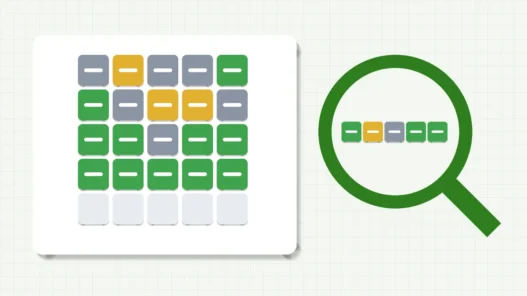
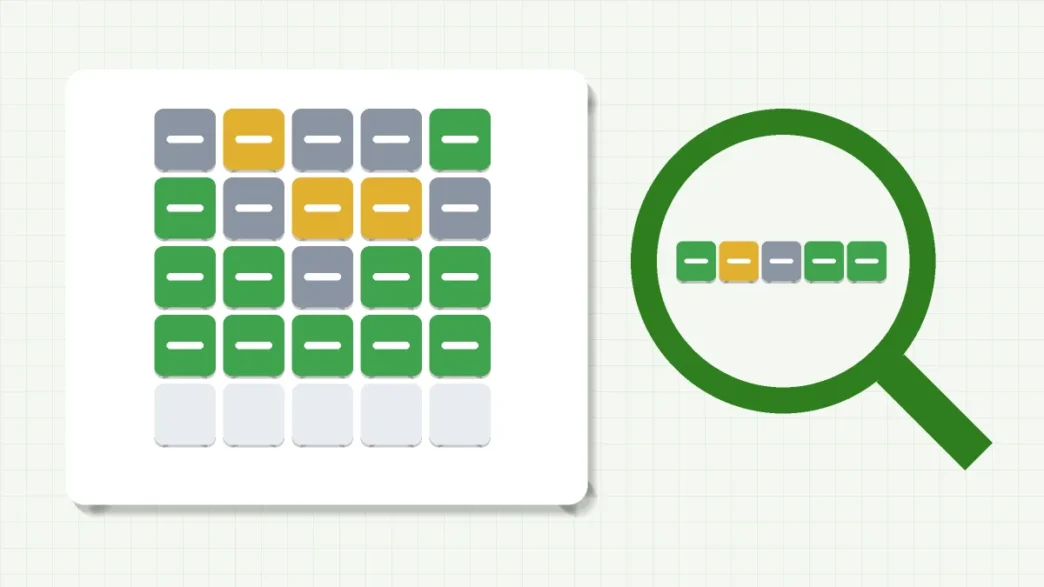
If your first word leaves most letters gray, use a second word with five new common letters, such as one built from O, L, N, D and I. If you already have green or yellow letters, switch to words that fit the clues. Keep an eye on the pattern: when you have four letters and the word could be one of many (like _ATCH or _IGHT), use a guess that tests several of the possible starting letters at once.
Common mistakes
- Guessing a word that cannot be right given the clues, just to test a letter.
- Forgetting that a yellow letter cannot go where it was yellow.
- Forgetting that double letters exist: a word like geese repeats the E.
- Switching to a new random opener every day instead of learning one well.
Frequently asked questions
Is there a perfect starting word?
Not really. Several strong openers perform almost identically, so the gap between the very best and a sensible choice is small.
Should I always use the same starter?
It helps. You learn what each result means for that word, and your second guess becomes faster.
Should I use the finder on every guess?
For learning, try the puzzle alone first and use the 5 letter word finder to check your reasoning afterward.
Summary
Open with five common, different letters, pick a favourite starter, and build the second guess from what the first one told you. When you are stuck, the 5 letter word finder narrows the list for you.
Free, runs in your browser, nothing uploaded, no sign-up.
Keep reading
More from Writing & Text Tools.


Tools for this job
Free, in your browser, no sign-up.
 Word Unscrambler
 Invisible Character Detector and Remover